
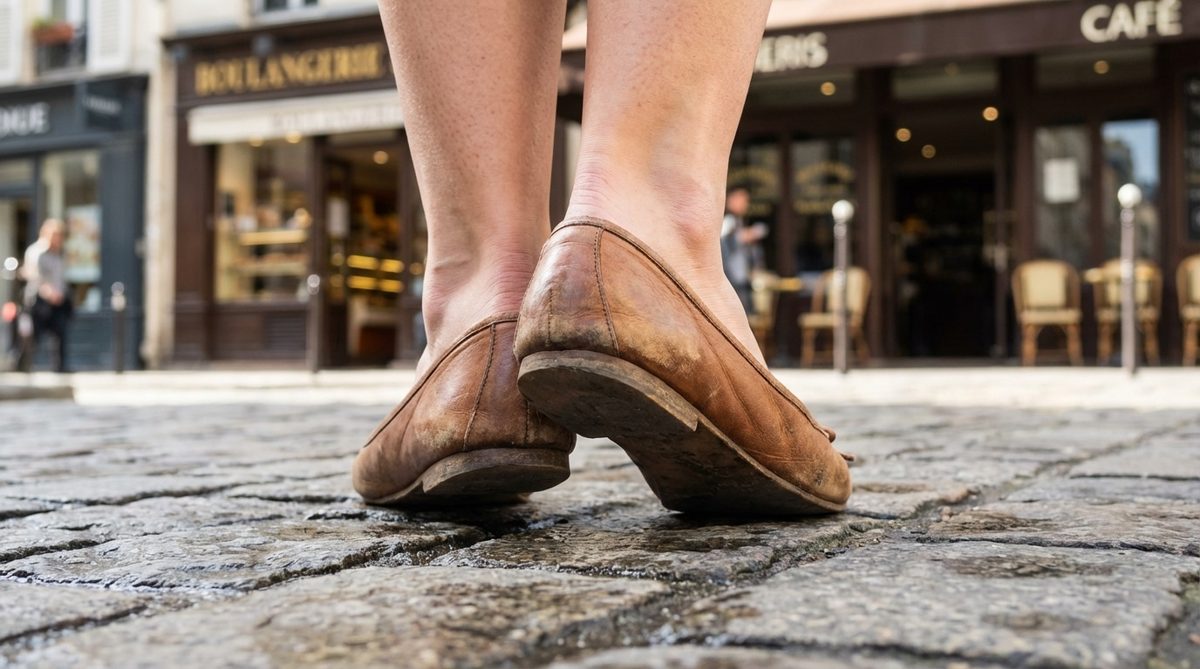
Slip them on. The soft leather yields. You feel a sudden, sweet certainty that you’ve made the right call. It’s spring. The weather is coaxing you out for a stroll through the city streets. You want to glide. You want to look effortless.
Yet, this shoe—widely praised as the perfect compromise between style and comfort—is hiding a red flag. Osteopaths are raising alarms. The classic ballerina, especially those with sagging soles, is often the worst enemy of your spine.
It’s not just about aesthetics. It’s biomechanics. And the damage starts at the ground up.
The Illusion of Instant Comfort
The trap is seductive because it feels good immediately. You walk into the store. You see a pair that matches your mid-season outfit perfectly. You slide your feet in.
It feels like wearing a cloud.
The material is supple. Your toes spread out, relieved after months of confinement in winter boots. You imagine navigating cobblestones with feline agility. This immediate relief is a lie. It’s a sensory trick that masks a structural void.
A Ghost of Support
Look closer. There is nothing there.
Your ankle dances loosely inside the shoe. There is no rigid counter to secure the heel. No vital strap to stabilize the rear foot. Without this support, your foot must work overtime to stay inside the shoe.
Your toes instinctively curl forward, gripping the front. It’s an invisible muscular effort. You don’t feel it at first. But soon, the entire kinetic chain tires out. The arch collapses. The foot overpronates. And the damage begins.
The Soles That Sabotage Your Posture
Ballerinas ignore human anatomy. They impose a flat surface on a structure designed to have a curve.
The absence of cushioning is the first offense. The sole is often just a few millimeters of thin material. Every step sends a shockwave straight through the skeleton. No filter. No shock absorption. The asphalt becomes an aggressive surface. Your muscles take the brunt of the micro-trauma.
The collapse of the arch is the second. Without a contoured insole to support the plantar fascia, the arch flattens. Ligaments stretch beyond their natural limit. The foot loses its ability to act as a spring. It becomes a rigid, flat platform.
The Domino Effect: From Feet to Neck
Your body is a connected machine. If the foundation is unstable, the whole building sways.
When the arch collapses, the tibia rotates internally. Your knees follow, turning slightly inward. This misalignment shifts the axis of the hips. The pelvic tilt changes. The lumbar curve exaggerates to compensate.
The lower back pays the price. Muscles tense up to maintain verticality. Inflammation sets in. After a long day of walking, you feel that sharp pain just above the glutes. It doesn’t stop there. The tension travels up. The cervical spine stiffens in solidarity. Your entire posture has been distorted by a shoe that offers zero support.
Rapid Wear and Tear
These shoes degrade quickly. The materials are often too thin to last. The inner foam compresses. The leather stretches. The structure disintegrates within weeks.
This isn’t sustainable fashion. It’s disposable footwear that compromises your health.
Check the sole. If the heel is worn asymmetrically, your posture is already off. If one side is flatter than the other, the ankle will tilt into that void. Don’t try to save an asymmetrical pair. It’s a threat to your joints.
Who Is Most at Risk?
Not everyone suffers equally. But some profiles are in danger.
- Flat feet: Without a natural arch, the lack of support in a ballerina is catastrophic. Pain sets in quickly.
- Hypermobility: If your joints are naturally loose, you rely on muscle tension for stability. A flat shoe removes that stability entirely.
- Long standing periods: Commuters who stand on train platforms or shop for hours face higher risks. Static pressure blocks venous return. Legs swell. The fatigue is worse than from active walking.
The ballerina promises ease. It delivers pain.
Which shoes actually protect your spine? That’s a conversation for next time. For now, look at your feet. Look at your soles. And ask yourself if that “cloud-like” comfort is costing you your back.
The answer might be hiding in the trash bin.
The non-negotiables for choosing a healthy shoe alternative
Convenience does not have to kill elegance. Finding the right balance comes down to three specific structural pillars. First, the material must hold the ankle securely. Second, the front of the sole needs flexibility. Third, there must be clear arch support built into the design. You are looking for what experts call an internal galbe.
Focus your search on structured loafers or soft yet substantial derbies. These styles provide the necessary framework to keep your feet aligned. Flimsy options simply won’t cut it.
The secret to choosing the right structured heel height for back pain
The ultimate trick for sparing your back is the height of the heel block. A difference of about three centimeters works miracles for posture. This slight elevation shifts your body weight forward. It reduces the pressure on the lumbosacral hinge—the pivot point in your lower back where most pain accumulates.
Look for elegant trotters or spring ankle boots. They offer that vertical lift. It is a small change that prevents the cascade of pain that follows poor foot mechanics.
We traded comfort for the simplicity of flat ballet flats. We thought we were being light on our feet. Instead, we altered our posture and overworked our backs. The lack of support, combined with the inevitable crushing of thin soles, causes mechanical imbalances. These issues travel straight up the spine.
The solution is not to abandon style. It is to swap those sagging models for shoes with a slight heel, proper support, and a structured sole. You can maintain daily elegance and joint health simultaneously. The question is whether you are ready to purge the closet before the season fully sets in.