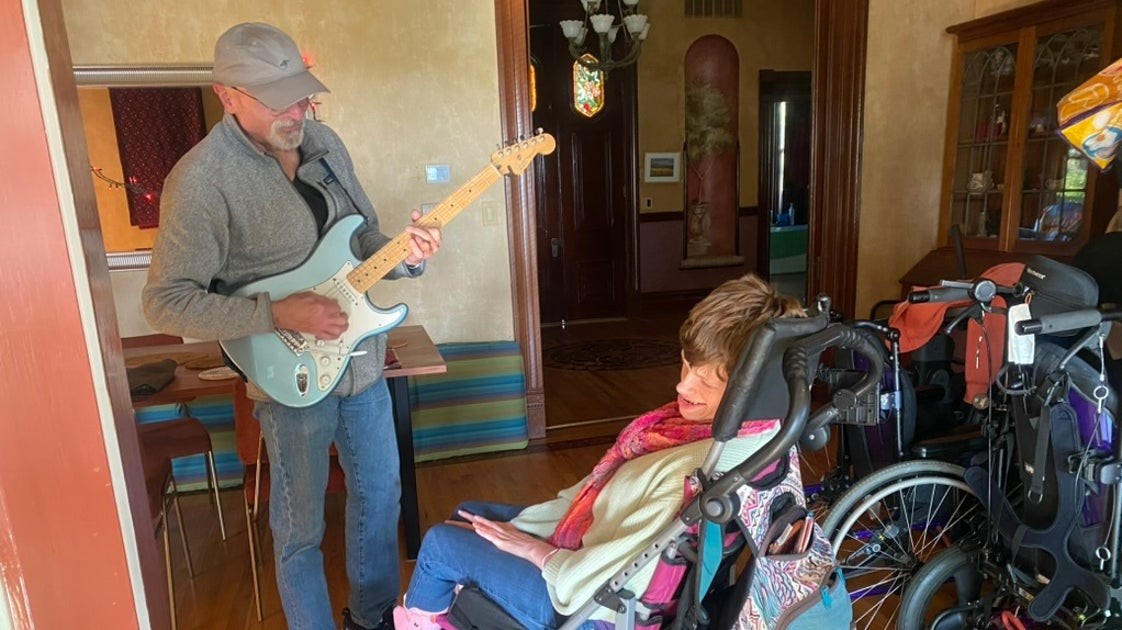
Millie, a 25-year-old woman with profound disabilities, does not walk, feed herself, or communicate through speech or signs. Yet, she exists in a world defined by rhythm and anticipation. When her husband plays a blues riff on his electric guitar, Millie recognizes the pattern. As the chords shift from G to C and back, she grins, swings in her rocker, and laughs at the predictable resolution of the music. Even when he hums the rhythm without instruments, she responds with joy.
“She lives knowingly in music, at play in the interval between beginnings and ends.”
This moment highlights a profound truth: Millie may not tell stories, but she understands them. She grasps the fundamental human tendency to seek patterns—the “tock” that follows the “tick.” For parents of children with severe, undiagnosed conditions, this understanding of pattern is often the only certainty left.
The Weight of the Unknown
Millie’s condition remains a medical mystery. At 10 months old, she failed to meet developmental milestones: no smiling, no eye contact, no babbling. Initial genetic tests ruled out common syndromes like Rett or Angelman. For years, her parents operated under the assumption that she was simply “delayed,” focusing on therapies to help her catch up.
The perspective of her parents shifted dramatically when Millie’s father died suddenly of a heart attack. This tragedy stripped away long-term planning, forcing them to accept Millie as she was, without labels or roadmaps. They secured necessary support—wheelchairs, school services, and care—and found peace in the present.
However, a new crisis emerged in Millie’s late teens. The medication that had controlled her seizures since age seven stopped working. Her seizures worsened, raising the specter of sudden unexpected death. This shift reignited the desperate need for a diagnosis.
Why a Diagnosis Matters
For many parents, a diagnosis is not just a label; it is a prognosis.
- Life Expectancy: Without a diagnosis, Millie’s parents had no idea how long she would live. A diagnosis could provide statistical averages, allowing for realistic planning.
- Medical Management: Knowing the specific genetic cause can guide treatment, prevent complications, and connect families with specialized care.
- Community: It links families to others facing similar challenges, reducing isolation.
In 2024, fearing Millie might not survive her twenties, her mother enrolled her in the Undiagnosed Diseases Network (UDN). This initiative uses cutting-edge genomic sequencing to identify rare genetic anomalies. The hope was to find a “de novo mutation”—a random genetic error that caused Millie’s condition—so they could prepare for the worst.
The Shock of “Nothing”
In November 2025, after months of waiting, the family received their results via Zoom. The genetic counselor delivered the news bluntly: “Nothing.”
No known pathogenic variants were found. No match for Rett Syndrome, no clear genetic marker. Initially, this felt like a void. But then, a different emotion emerged: wonder.
“There’s something beautiful about the fact that Millie isn’t like anyone else.”
The absence of a diagnosis lifted the immediate fear of a known, fatal trajectory. Millie was not a statistic from a textbook; she was unique. While this left her medical future uncertain, it also freed her from the constraints of a predictable, often grim, disease narrative.
The Long Game of Science
The search did not end there. During the follow-up, researchers identified a potential anomaly in the FOXG1 gene. This gene is associated with FOXG1 syndrome, a rare condition affecting brain development.
- Current Knowledge: Most known cases of FOXG1 syndrome involve young children. Few adults are documented, suggesting either low survival rates or undiagnosed cases.
- Research Potential: FOXG1 is also linked to Alzheimer’s disease, attracting research funding. A parents’ group is sponsoring studies that may lead to clinical trials.
- The Reality Check: The genetic counselor warned that even if a mutation is confirmed, it could take a decade or more to find another patient with the same anomaly. Treatment breakthroughs are not imminent.
Millie’s mother, accompanied by her sister (a geneticist), realized that this quest was no longer just about Millie’s immediate care. It was contributing to a broader scientific understanding.
“We don’t know what caused Millie… But someday someone will know. There’s something beautiful about that, as well.”
Conclusion
Millie’s story illustrates the complex reality of living with an undiagnosed disability. It is a life suspended between hope and uncertainty, where medical silence can be both terrifying and liberating. While science may one day decode her genome, Millie’s worth is not defined by a genetic label. As her 90-year-old caregiver joked, “She’s been faking it all along.” In the end, Millie defies expectations, living fully in the present, proving that life expectancy is merely a statistic, not a destiny.