



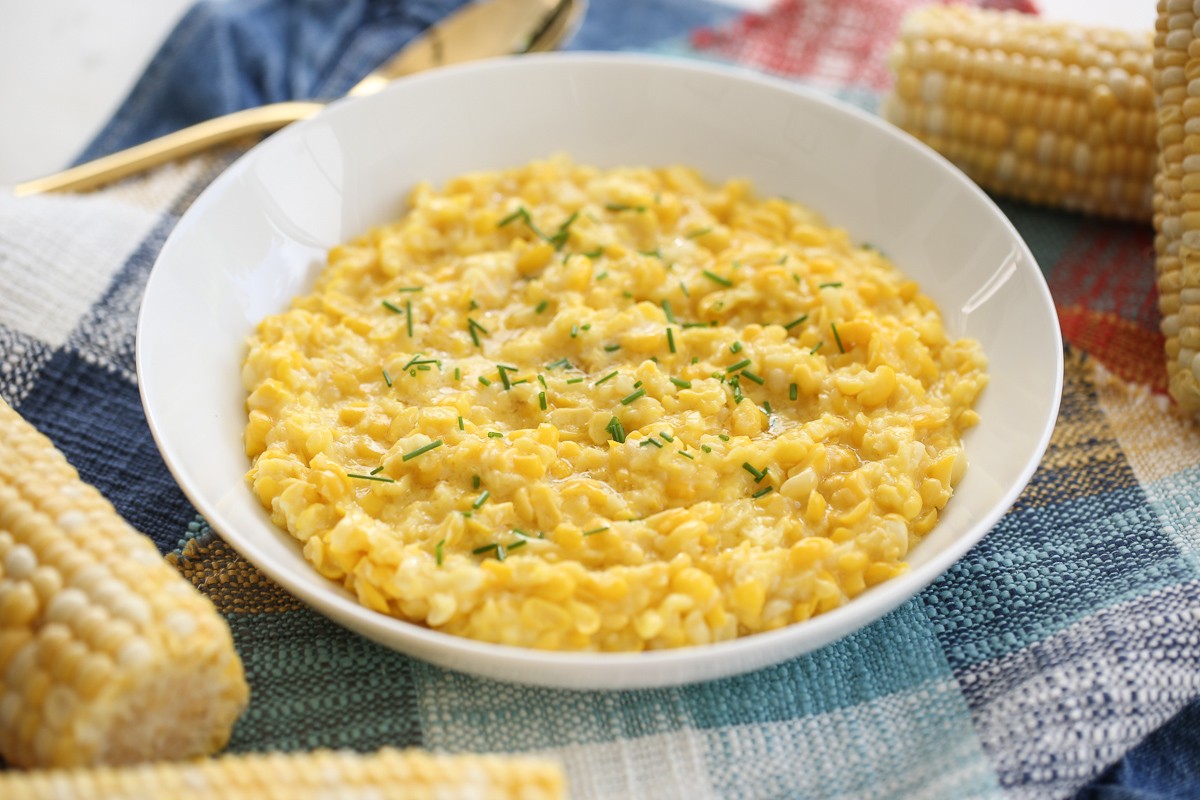
Forget the milk. Forget the cream. Forget the flour entirely.
This Southern-style creamed corn works by exploiting what corn actually is. The kernel is full of starch and juice. If you cut it right, it thickens itself. It’s gluten free. It can be dairy free, if you’re feeling fancy with your butter swaps. But mostly it’s fast. Ten minutes from raw to rich.
People expect creamed corn to be heavy. Sloppy. This isn’t. It’s bright yellow. Dense like pudding, but lighter than custard. And it only requires cobs.
The ingredients list is a joke
You need four things.
Fresh corn. Real butter, obviously, unless you have a strong moral stance against cows. Salt. Maybe some smoke, maybe some chives. Whatever makes your mouth happy.
Do not buy frozen cobs. I’ve tried to scrape juice from ice-cold, vacuum-packed corn and failed. It won’t release its secrets unless it’s warm and fresh. The four-packs in the plastic trays? Those are your friends. Grab two of those.
The technique gets messy
This part makes a mess. Accept it. Use a deep pot, or clean your stovetop immediately after.
Take a sharp knife. A serrated one helps, honestly. Cut just the tips off the kernels. Not the whole ear. Just the crowns. Drop those into the pot.
Now take the cob. Turn it over the pot. Scrape down.
Hard.
Push the straight edge of your knife down the cob, squeezing every last bit of pulp and juice from the base of the kernel. You aren’t cutting the cob. You are milking it.
Keep scraping. All four cobs should end up looking like naked teeth by the end. You should have a pile of thick corn slush at the bottom of your pot.
Heat it.
Medium-high heat works. Stir it. Watch it darken. Watch the liquid reduce. It starts bubbling. That’s the starch activating.
When it thickens—about three minutes, maybe four—dump in two tablespoons of butter. A pinch of salt. Keep stirring.
The mixture transforms. It goes from watery to glossy. Dark yellow. Soft. If you lift the spoon, the mixture should fold slowly, like soft scramble or thick pudding. Not runny. Not dry.
Eat it hot. Add extra salt if your tongue says so. Add smoked paprika if you like drama. Leave it plain if you trust the corn.
Storage and leftovers
Leftovers exist. They survive in an airtight container for four days in the fridge. Five is pushing it, but your taste buds might still forgive you.
It reheats poorly in the microwave, usually turning out rubbery if you blast it. Reheat gently on the stove. Low heat. Add a splash of water if it looks too thick. It fixes itself easily.
You can freeze it, too. Thaw it overnight in the fridge before warming. Don’t skip the thaw or you’ll get a cold center that never quite catches up.
“The corn turns deep yellow, thickening until it looks like soft scrambled eggs. That is the finish line.”
Why do we add cream?
We don’t. That’s the point. Traditional recipes drown corn in heavy cream or béchamel. That masks the flavor. It turns corn into beige mush. This method forces the corn to be the hero. It relies on the natural juices. It tastes like actual corn, amplified.
If you’ve ever eaten dry creamed corn at a church supper, you know what failure looks like. It sits there, gloomy and separated. This version shines. It has body.
Adjust the butter to your liking. Two tablespoons is a starting line, not a law. If you want it richer, add more fat. If you want it cleaner, skip it, though I beg you not to. Butter carries the heat. Butter makes it taste like the summer you remember, not the winter you’re living in.
Sara Wells developed this. She’s written books, been in magazines, and apparently figured out how to make corn work without dairy decades ago. It’s efficient. It’s cheap ($3 for the whole pot, really?). It’s done while your main course finishes roasting.
Serve it warm. Eat it fast. Wonder why we ever bothered with milk at all.
Nutrition facts are boring but here: 128 calories per half cup. Mostly carbs and a little fat. Nothing dangerous. Just corn.
Try it once. See if the texture shocks you. It probably will. In a good way. Or a bad one, depending on how much you trust a knife-scraped pulp to be food.


